Microsoft & Google Throw Down the AI Gauntlet - The AI Arms Race Heats Up - Beyond OpenAI: The New AI Frontier
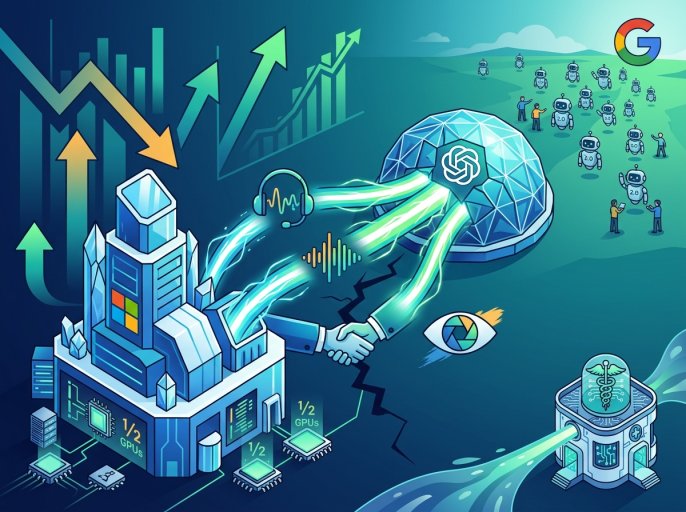
Microsoft is no longer just OpenAI's landlord. This week, the company released three in-house AI models for transcription, voice, and image generation, a direct competitive shot at its $13-billion partner and the clearest signal yet that their symbiotic relationship is entering a new, more adversarial phase.
PLUS: Google drops Gemma 4, its latest open model, under a permissive Apache 2.0 license. PLUS: A medical AI startup claims its specialized model blows general-purpose LLMs from the giants out of the water on clinical accuracy.
The thing you need to understand about this week's AI model dump is that it has nothing to do with a breakthrough in reasoning and everything to do with cloud economics, investor anxiety, and the renegotiation of a single contract clause. It feels like the industry is pivoting from a land grab to a trench war, where the weapons are pricing sheets and exclusivity agreements.
The Independence Clause ProblemFor years, the partnership between Microsoft and OpenAI was framed as symbiotic. Microsoft provided the capital and the cloud; OpenAI provided the magic. The dependency ran deep. But according to people familiar with the partnership, that arrangement began to chafe inside Microsoft's executive suites as the AI market exploded. The turning point was a deal announced last October. The new terms, as reported by VentureBeat, allowed both companies to "independently pursue AGI... alone or in partnership with third parties."
That single clause was a tectonic shift. It functionally uncorked Microsoft's ambitions. Mustafa Suleyman, the DeepMind co-founder Microsoft installed to lead its AI efforts, quickly formed a "superintelligence team" with the explicit goal of making the company "self-sufficient in AI." This week's models—MAI-Transcribe-1, MAI-Voice-1, and MAI-Image-2—are the first fruits of that labor, hosted exclusively on Microsoft's own Foundry platform. They compete directly with OpenAI's Whisper, text-to-speech models, and DALL-E.
Suleyman tells VentureBeat Microsoft is now "a top three lab just under OpenAI and Gemini." The message is clear: the tenant is building a mansion right next door. The partnership remains, but its nature has irrevocably changed. It's a hedge, and one that gives Microsoft leverage in every future negotiation with its most important AI supplier. Not anymore is Microsoft content to be just the infrastructure provider.
The COGS ProblemWhy now? Follow the stock price. Microsoft just closed its worst quarter since 2008. Investors, after years of cheering capital expenditures measured in the tens of billions, are getting impatient for actual returns on all that AI infrastructure spending. The new models are priced aggressively—MAI-Voice-1 starts at $22 per 1 million characters, MAI-Image-2 at $5 per 1 million input tokens—which Suleyman explicitly frames as a cost-play: "We're pricing them to be the very best value in the industry."
Here’s the question no one is asking at the product launch: What's the margin? The stated technical boast is that these models achieve their results with "half the GPUs of the state-of-the-art competition." In a March memo cited by VentureBeat, Suleyman wrote that his models would "enable us to deliver the COGS [Cost of Goods Sold]... that will power the next decade of AI." This isn't just about offering another API. It's about proving to Wall Street that Microsoft can build and run AI cheaper than anyone else, turning its cloud-scale efficiency into a weapon. The competition is no longer just about whose AI is smarter. It's about whose AI is cheaper to serve.
The Open Model Doppelgänger ProblemWhile Microsoft works on its OpenAI doppelgänger, Google is pursuing a different form of competition: commoditization through openness. The release of Gemma 4 under an Apache 2.0 license is a strategic move aimed at the heart of the startup and open-source ecosystem. Google's claim is one of efficiency: Gemma 4 models "outcompetes models 20x its size." They're offering four sizes, down to an "Effective 2B" parameter model designed to run on a Raspberry Pi or phone.
The thing you need to understand about Google's open model play is its dual nature. It simultaneously undermines smaller commercial open model companies (why pay for a 7B model when a best-in-class 4B is free?) while serving as a top-of-funnel driver for Google Cloud. It's a classic embrace-extend-extinguish tactic wrapped in the language of developer empowerment. By making a capable model truly open and free for commercial use, Google pressures the entire mid-tier of the market and entrenches its tools and platforms as the default development environment. I find myself asking sources: is this generosity, or is it a price war where the price is zero?
Following: The Vertical SliceCorti, a clinical AI lab, this week launched its "Symphony for Medical Coding" API. Its benchmark claim is the kind that should worry the general-purpose model giants: outperforming LLMs from OpenAI, Anthropic, Google, and others by more than 25% on clinical accuracy. The CEO notes that medical coding is treated as a "back-office cost center," but is in fact "the data layer that healthcare runs on."
This is the other end of the spectrum from Google's general-purpose open model. It's a deep, vertical-specific solution that argues generic LLMs are "highly advanced autocomplete engines" unsuited for complex, guideline-driven reasoning. When tested on Danish patient data, Corti's system identified three times as many suicide attempts as human coders had. The implication is stark: the real value—and the defensible business—may not be in the biggest, most general model, but in the one that best understands a single, critical domain. It’s a rejection of the frontier model race altogether.
So where does this all end? We have Microsoft building clones of its partner's products to save on COGS. Google releasing sophisticated open models to commoditize the competition. And startups arguing the whole general-purpose race is missing the point. The splinternet isn't just geopolitical anymore; it's forming along model lines—proprietary vs. open, general vs. vertical, partner vs. competitor.
The market is demanding profitability, and the giants are responding by turning on each other and the ecosystem they fostered. The collaborative "AI for humanity" phase feels distant. We're in the consolidation play now. The question for the next quarter is, who runs out of leverage—or money—first?
Talk to us
Send tips, comments, and questions. We read everything, even if we can’t respond to all of it.