AI Engineering: Building Apps on Foundation Models
1. Introduction to AI Engineering
The video introduces AI Engineering as a fast-growing, high-salary field focused on building applications using pre-trained foundation models (like those from OpenAI or Google), rather than building models from scratch like traditional Machine Learning. This discipline has exploded because the models have become dramatically more capable and easier to use. The core difference is that AI engineers adapt existing models for specific tasks through techniques like prompt engineering and fine-tuning, leveraging the model's broad base of knowledge acquired through self-supervised learning on vast amounts of data.
2. Foundation Models & Architecture
Foundation models are large AI systems trained on massive, often web-crawled datasets. Their knowledge is limited to their training data, which can contain biases, misinformation, and language imbalances. The breakthrough enabling them is the Transformer architecture, which uses an "attention mechanism" to weigh the importance of different words in a sequence, allowing for parallel processing and understanding context much better than previous sequential models (like RNNs). This architecture consists of multiple blocks with attention and neural network modules, converting text into vectors (embeddings) and back.
3. Model Training, Scaling, and Limitations
Training these models follows scaling laws (like Chinchilla), which balance model size and training data for optimal performance. However, scaling faces two major bottlenecks: the potential exhaustion of high-quality internet training data and the immense electricity consumption of data centers. Furthermore, raw pre-trained models are optimized for text completion, not conversation, and can produce incorrect or unethical outputs. This necessitates a post-training process involving supervised fine-tuning (to teach conversational response formats) and preference fine-tuning (like RLHF) to align the model's outputs with human values and safety.
4. Probabilistic Nature and Sampling
Foundation models don't give a single definitive answer but generate probabilities for possible next words (tokens). How we sample from these probabilities—using techniques like temperature (controlling randomness), top-k (limiting choices to the k most likely), and top-p (nucleus sampling)—directly affects the creativity, focus, and consistency of the output. This probabilistic core explains model behaviors like hallucinations (confidently stating false information) and sensitivity to minor input changes.
5. Evaluation Challenges and Methods
Evaluating AI systems, especially open-ended ones, is significantly harder than traditional ML. Challenges include the complexity of tasks (e.g., judging a summary), the lack of single correct answers, the "black box" nature of models, and the quick saturation of public benchmarks. Key evaluation metrics include perplexity (measuring prediction uncertainty) for training, and functional correctness (does the output work?) for applications. Methods range from exact match and lexical similarity (e.g., BLEU) to semantic similarity using embeddings. A powerful and common technique is using another AI model as a "judge" to score outputs for attributes like correctness or toxicity, though these judges can have biases.
6. Model Selection Strategy
With many models available, selection is a crucial, iterative process. It involves filtering models by "hard attributes" (e.g., license, privacy needs) and then evaluating "soft attributes" (e.g., accuracy) that can be improved. The decision between using a commercial API (easier, scalable, but less control, potentially costly) and hosting an open-source model yourself (more control, better privacy, but requires more expertise) depends on factors like data privacy, cost, performance needs, and desired flexibility. The process requires rigorous testing with your own data and benchmarks, as public leaderboards can be misleading due to data contamination.
7. Prompt Engineering
Prompt engineering is the art of crafting instructions to guide a model to a desired output without changing its weights. It's an accessible but nuanced technique requiring experimentation. Effective prompts can include a task description (role, format), examples (few-shot learning), and the concrete query. Strategies include being clear and explicit, asking the model to adopt a persona, breaking complex tasks into steps, and encouraging chain-of-thought reasoning. It's also critical to defend against prompt injection attacks by using system prompts, guardrails, and anomaly detection.
8. Retrieval-Augmented Generation (RAG)
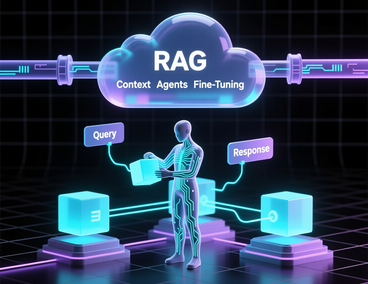
RAG is a technique to give a model access to external, up-to-date, or private information it wasn't trained on. It works by retrieving relevant document chunks from a knowledge base (using term-based keyword search or embedding-based semantic search) and inserting them into the prompt for the model to use as context. Key considerations include how to chunk documents, how to rank retrieved results, and possibly rewriting user queries for better retrieval. RAG can be used with multimodal data (images, tables) and is often a more straightforward solution than fine-tuning for knowledge gaps.
9. Agents and the Agentic Pattern
Agents are AI systems that can perceive an environment (e.g., a database, the web) and take actions using tools (e.g., search, API calls, code execution) to accomplish multi-step goals. They go beyond passive retrieval (RAG) to actively plan, execute, and iterate. Building agents involves defining available tools, generating and validating plans (often via prompt engineering or specialized training), and managing memory across interactions. Evaluation is complex due to compounding errors across steps, and safety is paramount as agents gain capability to affect the world.
10. Fine-Tuning
Fine-tuning is the process of further training a pre-trained model on a specific dataset to adapt its behavior, such as improving performance in a domain or following specific output formats. It requires more resources than prompting or RAG. Techniques like Parameter-Efficient Fine-Tuning (PEFT), especially LoRA (Low-Rank Adaptation), allow effective adaptation by training only small, additional sets of parameters, reducing computational cost. The choice to fine-tune should come after exhausting prompt engineering and RAG, and it's particularly useful for correcting behavioral issues or distilling a large model's capability into a smaller one.
11. Dataset Engineering
The transcript emphasizes a shift from model-centric to data-centric AI, where competitive advantage often comes from high-quality, tailored datasets. The type of data needed depends on the adaptation task (e.g., instruction-response pairs for fine-tuning). Quality—encompassing relevance, accuracy, consistency, and coverage—is more important than sheer volume. Strategies to acquire data include creating a user feedback flywheel, data augmentation, and synthetic data generation. Meticulous data processing (deduplication, cleaning, formatting) is essential for performance.
12. Inference Optimization
This involves making model deployment fast and cost-effective. Key concepts include understanding bottlenecks (compute-bound vs. memory-bandwidth bound), measuring performance via latency (time to first token, time per output token) and throughput, and choosing the right hardware (GPUs). Optimization techniques span multiple levels: model-level (quantization, pruning), system-level (batching requests, especially continuous batching), and low-level (kernel optimization, specialized compilers). The goal is to balance latency for user experience with throughput and cost for scalability.
13. System Architecture and Observability
Real-world AI applications evolve from simple API calls to complex architectures. This involves adding context construction (RAG, agents), guardrails for safety and quality, model routers and gateways to direct queries to specialized components, caching for performance, and orchestration tools to manage workflows. Crucially, implementing robust monitoring and observability—logging everything to detect, diagnose, and fix issues—is essential for maintaining a reliable production system. The architecture should start simple and only add complexity as needed to solve specific problems.
14. The Feedback Loop and Conclusion
A mature AI system leverages user feedback (both explicit ratings and implicit behavior) as a proprietary asset for continuous improvement. This creates a virtuous cycle where user interactions generate data to refine models, prompts, and datasets. The field of AI engineering brings together all these components—model understanding, evaluation, adaptation techniques, data craftsmanship, optimization, and system design—to build effective, scalable, and reliable applications on top of foundation models.
This article is based on the transcript of this video: https://www.youtube.com/watch?v=JV3pL1_mn2M