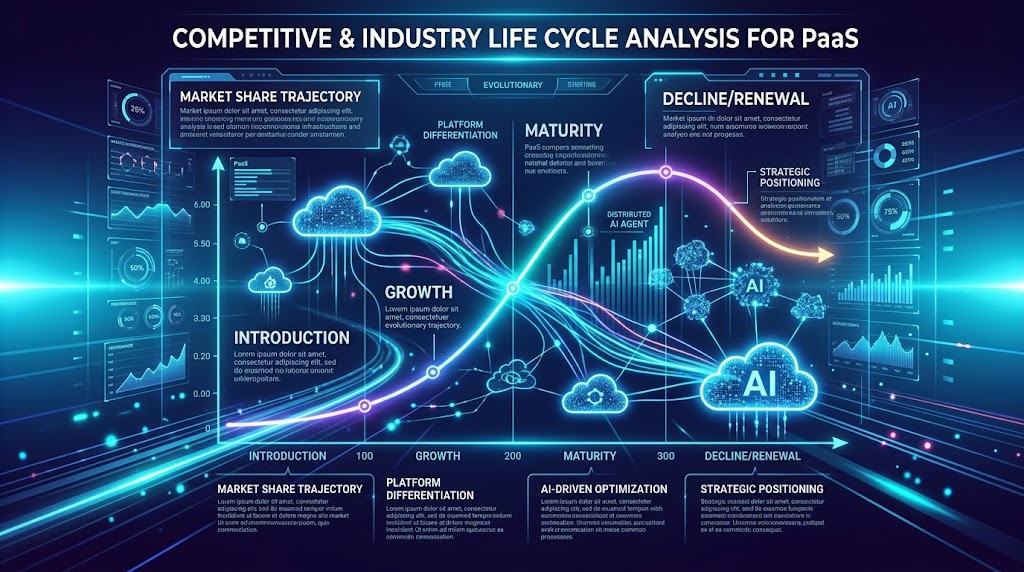
Competitive & Industry Life Cycle Analysis: Platform as a Service (PaaS)
ILC Evolutionary Trajectory, Dominant Design Convergence & Market Velocity Blueprint • 2026-09-03
Life Cycle Phase: PHASE II: RAPID GROWTH | ACTIVE UNBUNDLING-TO-REBUNDLING TRANSITION | Evolution Velocity: HYPER-DYNAMIC | RAPID CLOCK-SPEED (AI-DRIVEN ABSTRACTION CYCLE)
The global Platform as a Service (PaaS) market is undergoing an accelerated Phase II expansion, scaling from $127.4B–$140.63B in 2025–2026 toward $214.37B–$344.4B by 2030–2031 at compound annual growth rates ranging from 11.1% to 16.55% according to The Business Research Company and Mordor Intelligence. The sector sits at an inflection point where initial architectural unbundling into specialized frontend, edge, and serverless runtimes is colliding with rapid rebundling driven by AI coding assistants, generative streaming, and Model Context Protocol (MCP) agentic orchestration as highlighted by RedMonk and Railway. For a modern frontend cloud platform optimized for Next.js, full-stack JavaScript, serverless AI workloads, edge rendering, and stateless execution, the market presents immense expansion momentum but demands strict architectural positioning against hyperscaler lock-in and persistent daemon/stateful workload constraints analyzed by Encore.
Executive Summary & Life Cycle Timing Strategy
The PaaS industry has exited its 'lost decade' of manual Kubernetes orchestration and entered a hyper-growth renaissance where developer abstractions are moving higher up the stack, reinforced by the finding that 95% of new digital workloads will deploy on cloud-native platforms by 2026 as tracked by Gartner. However, technological ferment is intensifying as specialized frontend/edge abstractions collide with emergent 'agentic PaaS' and 'NeoPaaS' categories analyzed by Forrester and RedMonk. Modern platforms optimized strictly for Next.js, full-stack JavaScript, and stateless serverless AI execution must navigate an impending structural shakeout. Because pure stateless architectures cannot natively host persistent WebSockets, continuous daemons, or long-running background tasks without external orchestrators, the venture must secure dominant workflow lock-in across Git-native preview loops, edge inference caching, and agent-driven MCP provisioning before hyperscalers (controlling 68% of cloud infrastructure revenue per Mordor Intelligence) and multi-workload PaaS consolidators absorb the standalone frontend layer.
Core Strategic Dimensions & Empirical Findings
1. 1. Life Cycle Stage & Evolutionary Timeline (Emergent to Mature)
Category: ILC TRAJECTORY | Status: PHASE II: RAPID GROWTH (Unbundling Transitioning toward Rebundling Shakeout) | Epoch: Emergent (2007–2020) | Renaissance & Rapid Growth (2020–2028) | Mature Consolidation (2029+) |
Growth-to-Shakeout Transition & Window of Opportunity: Following the original 2007 Heroku contract and the subsequent Kubernetes infrastructure era, PaaS entered an aggressive expansion wave where the market reached $160.14B in 2026 and is forecast to expand to $344.4B by 2031 at a 16.55% CAGR according to Mordor Intelligence (2026), with alternative research from Fortune Business Insights (2026) projecting expansion to $693.29B by 2034 at a 17.06% CAGR.
Key Drivers, Standards & Evidence
- The overall PaaS market is expanding from $127.4B in 2025 to $140.63B in 2026 (10.4% CAGR) and reaching $214.37B by 2030 (11.1% CAGR), driven by enterprise cloud migration, agile developer environments, and edge computing expansion as reported by The Business Research Company (2026).
- Public PaaS dominates the deployment mix with a 64.05% revenue share, while Database PaaS accounts for 44.72% of total spend and Integration PaaS expands at the fastest trajectory with a 22.96% CAGR through 2031 as documented by Mordor Intelligence (2026).
- AI inference PaaS is accelerating at a 41.1% CAGR, projected to reach $105.22B by 2030, while 50% of all cloud compute is forecast to be AI-driven by 2029 as analyzed by Calliber Research (2026) and Adam Reeves at IDC (2026).
Venture Strategic Implications & Friction
- Massive demand-side tailwinds allow low-friction organic developer adoption for stateless frontend and serverless AI applications across SME and enterprise cohorts documented by Fortune Business Insights (2026).
- Vulnerability to high churn and margin compression once applications mature into multi-service backends or stateful architectures that outgrow serverless edge compute constraints detailed by Ivan Cernja at Encore (2026).
Strategic Mandate: Maximize developer acquisition velocity in the Next.js/AI full-stack segment before the window of independent frontend cloud fragmentation consolidates into generalized AI-native platform bundles.
2. 2. Dominant Design & Technological Standardization
Category: TECHNOLOGICAL TRAJECTORY | Status: ACTIVE FERMENT & EXTENSION (5-Contract Standardization + Agentic MCP Shift) | Epoch: Dominant Architecture Convergence Active (12–24 Month Window) |
Standardization of the Modern PaaS Contract & Edge-FaaS Hybrids: The industry dominant design is anchored by five foundational primitives: managed runtimes, buildpack/container abstractions, managed add-ons, Git-deploy loops, and environment promotion, while expanding into Model Context Protocol (MCP) agent interfaces as detailed by Angelo Saraceno at Railway (2026).
Key Drivers, Standards & Evidence
- Dominant developer workflows have standardized on Git-based deployment loops, Nixpacks/buildpack artifact generation, and automatic preview environments for every pull request according to Angelo Saraceno at Railway (2026).
- The boundaries between PaaS, edge compute, and FaaS are blurring, with frontend-specialized platforms like Vercel and Netlify executing workloads via edge microVMs and serverless functions (offering sub-5ms cold starts) alongside global CDN caching as analyzed by Ivan Cernja at Encore (2026).
- Emergence of 'NeoPaaS' and 'Agentic PaaS' as new dominant architectural tiers where platforms expose structured APIs and MCP servers so LLMs (Cursor, Claude, Codex) can provision databases, set environment variables, and trigger preview deploys autonomously as detailed by Charlie Dai and Lee Sustar at Forrester (2026) and Railway (2026).
Venture Strategic Implications & Friction
- Platform design must natively support streaming HTTP responses, Next.js Server Components, and sub-second auto-scaling to remain the benchmark UX for AI-native JavaScript applications as outlined by RedMonk (2026).
- Inability to natively host long-running background tasks, continuous WebSockets, or persistent daemon processes without external queue integrations creates an adoption ceiling when applications scale into complex microservices as shown by Angelo Saraceno at Railway (2026).
Strategic Mandate: Establish the venture's serverless AI edge rendering engine and MCP-native agent deployment tooling as the de facto standard runtime for modern Next.js and full-stack JavaScript architectures.
3. 3. Market Structure & Industry Concentration Dynamics
Category: MARKET STRUCTURE | Status: MODERATE CONCENTRATION & CROSS-TIER REBUNDLING | Epoch: Oligopolistic Core (Hyperscalers) with Unbundled Specialist Shakeout |
Bifurcated Landscape: Hyperscaler Scale vs. Unbundled Developer Clouds: The market reflects medium concentration where the top three hyperscalers—AWS (31%), Microsoft Azure (20%), and Google Cloud (13%)—control 68% of cloud infrastructure revenue as documented by Mordor Intelligence (2026), while specialized frontend and full-stack PaaS platforms compete aggressively on developer experience and abstraction speed.
Key Drivers, Standards & Evidence
- North America commands the largest market share (38.12% to 48.65%), while Asia-Pacific is the fastest-growing region compounding at 17.05% to 18.50% CAGR through 2031–2034 as validated by Fortune Business Insights (2026) and Mordor Intelligence (2026).
- The PaaS market is experiencing a rapid 'unbundling and bundling' cycle where unbundled specialized platforms (v0, Lovable, Bolt.new, Convex Chef, Replit Agent, GitHub Spark) are rapidly colliding into full-stack app builders and deployment platforms within compressed 10-to-25-month windows as documented by Stephen O'Grady at RedMonk (2026).
- Over 9.6 million companies globally utilize PaaS technologies, but 70%+ of enterprises exceed cloud budgets due to variable scaling and egress pricing, prompting teams to evaluate lock-in and egress boundaries as reported by Calliber Research (2026) and Mordor Intelligence (2026).
Venture Strategic Implications & Friction
- Head-to-head competition with hyperscalers on raw compute pricing or broad database infrastructure is unviable; differentiation must center on developer experience, Next.js framework synergy, and rapid Git previews as analyzed by Ivan Cernja at Encore (2026).
- Impending consolidation threatens specialized single-tier platforms as full-stack PaaS (Render, Railway, Fly.io) and AI builders expand their hosting footprints across adjacent workloads as highlighted by Stephen O'Grady at RedMonk (2026).
Strategic Mandate: Defend high-margin developer tiers by embedding deep framework optimizations and AI tool integrations while providing seamless third-party queue/data connectors to prevent workload attrition.
4. 4. Evolutionary Velocity & Innovation Clock-Speed
Category: INDUSTRY VELOCITY | Status: HYPER-DYNAMIC (Rapid Clockspeed & Agentic Compression) | Epoch: Quarterly Technical Shifts Driven by GenAI & Autonomous Agents |
Agentic Coding & Serverless Inference Clockspeed Acceleration: Innovation cycles in PaaS have accelerated drastically: coding assistants (vibe coding) and autonomous agents delegate infrastructure selection directly to AI models, which systematically favor lightweight, token-efficient, abstracted PaaS layers over complex IaaS primitives as analyzed by Stephen O'Grady at RedMonk (2026).
Key Drivers, Standards & Evidence
- Over 80% of software engineering organizations are using AI-augmented development platforms, while 70.6% of professional developers actively employ AI coding tools, driving massive spikes in deployed code volume as reported by Gartner & Stack Overflow via Calliber (2026).
- Low-code and AI-assisted application builders are projected to account for 70% of new applications by 2026, compounding at a 26.4% CAGR within the broader platform market as noted by Julie Robles at Enorivercapital (2026).
- Hyperscalers are deploying $660B–$690B in capex with 75% allocated to AI infrastructure, driving down inference compute latency and forcing PaaS vendors to ship model serving, streaming primitives, and GPU integration within continuous 6-month cycles as documented by Futurum Group via Calliber (2026).
Venture Strategic Implications & Friction
- Rapid feature shipping speed (e.g., instant preview generation, AI SDK streaming, zero-config edge middleware) serves as the primary barrier against slow-moving legacy enterprise platforms described by Angelo Saraceno at Railway (2026).
- Requires platform APIs to be fully machine-parseable and declarative, enabling AI coding agents (Claude, Cursor, v0) to deploy code, execute migrations, and manage preview environments autonomously via MCP as evaluated by Angelo Saraceno at Railway (2026).
Strategic Mandate: Maintain aggressive bi-weekly feature deployment clock-speed across serverless AI primitives and agentic MCP interfaces to outpace consolidating PaaS incumbents.
Industry Evolutionary S-Curve & Shakeout Trajectory Matrix
Lifecyclestage | Timelineestimate | Dominantcompetitivefactor | Marketstructurestate | Focalventureaction |
|---|---|---|---|---|
Emergent / Ferment Phase (PaaS 1.0) | 2007 – 2020 | Basic Git-Push Deployments, Buildpack Slugs & Developer Convenience | Heroku Monolith Era followed by Kubernetes Infrastructure Fragmentation | Identified operational burdens of raw IaaS/Kubernetes; established core serverless and Git-integrated edge concepts. |
Rapid Growth & Unbundling (Current Phase) | 2020 – 2028 | Framework-Specific Optimization (Next.js), Edge Rendering & Serverless AI Integration | Bifurcated: Hyperscaler Oligopoly (68% Core Share) vs. Fast-Growing Specialist PaaS (16.55% CAGR) | Scale stateless frontend cloud leadership, optimize instant preview CI/CD, and deploy native MCP servers for agentic coding tools. |
Shakeout & Rebundling Phase | 2028 – 2031 | Unit Economics at Scale, Multi-Region Governance, AI Inference Margins & Workflow Lock-in | Tightening Consolidation: Full-Stack Rebundling across App Builders, BaaS, and PaaS Providers | Mitigate stateless churn via seamless integrations with external queues, serverless databases, and enterprise egress governance. |
Maturity & Autonomous NeoPaaS Era | 2031+ | Autonomous Self-Healing Agent Platforms, Ubiquitous Edge Compute & Zero-Ops AI Pipelines | Mature Utility Infrastructure: Standardized AI-Native NeoPaaS & Enterprise Sovereign Zones | Serve as the high-speed edge rendering and autonomous deployment substrate across multi-cloud and sovereign enterprise architectures. |
Actionable Life Cycle & Velocity Recommendations
[Dominant Design & AI Agentic Standardization] Implement Native Model Context Protocol (MCP) and Declarative Agent-to-Platform Interfaces
Capitalize on the expanding PaaS contract by implementing first-class Model Context Protocol (MCP) server endpoints as highlighted by Angelo Saraceno at Railway (2026). As AI coding tools and vibe-coding agents (Cursor, Claude, v0) increasingly make infrastructure choices on behalf of developers, the platform must offer machine-parseable logs, idempotent preview provisioning, and structured environment variable manipulation without requiring human dashboard intervention.
[Workload Boundary Mitigation & Churn Defense] Establish Official Async Queue and Stateful Streaming Bridges to Circumvent Stateless Limitations
Because the platform is specialized strictly for stateless JavaScript/AI workloads and unsuited for persistent daemon processes or continuous WebSocket servers, applications risk migrating off to full-stack platforms like Render or Railway once they scale as documented by Angelo Saraceno at Railway (2026) and Ivan Cernja at Encore (2026). The platform must deliver native, zero-latency integrations with managed message brokers (Pub/Sub, Kafka, SQS) and serverless database add-ons on private edge networks to retain scaling multi-service architectures.
[Shakeout Survival & Pricing Transparency] Calibrate Usage-Based Pricing and Egress Guardrails to Prevent Enterprise Cloud Budget Overruns
With over 70% of enterprises exceeding cloud budgets due to variable compute and unexpected bandwidth markups noted by Mordor Intelligence (2026), the venture must institute predictable per-request and execution-time billing alongside automated quota limits and chargeback visibility. Transparent cost governance prevents enterprise developers from 'ejecting' to raw IaaS or code-first internal accounts as highlighted by Ivan Cernja at Encore (2026).
[Life Cycle Timing & Rebundling Defense] Preempt Multi-Workload Collisions by Deepening Next.js & Serverless AI Inference Framework Synergy
As AI app builders, BaaS providers, and general-purpose PaaS platforms merge across adjacent categories within 10-to-25-month cycles as detailed by Stephen O'Grady at RedMonk (2026), the venture must cement its competitive moat by embedding hyper-optimized caching, streaming LLM response primitives, and automatic Next.js build compilation that generic container PaaS alternatives cannot match.