The Virtual Private Servers Industry Competitive Life Cycle Analysis
Based on the provided market research data, the following is a Competitive Life Cycle (CLC) analysis of the virtual private servers (VPS) industry.
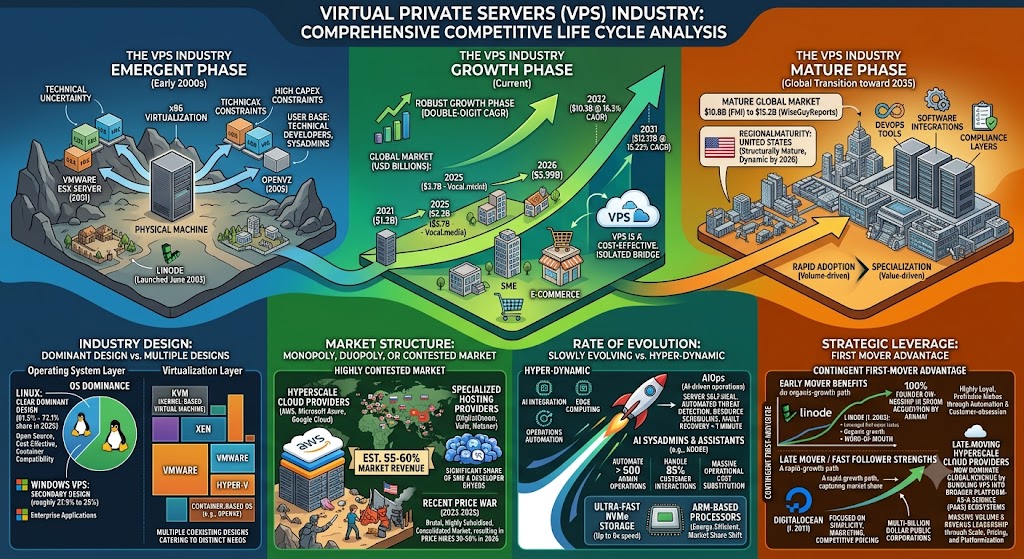
1. The Virtual Private Servers Industry Emergent PhaseThe emergent phase of the virtual private server (VPS) industry began in the early 2000s, driven by the commercialization of x86 server partitioning technologies VPS Blocks. Partitioning a single physical server to appear as multiple virtual servers gained commercial traction following the launch of VMware ESX Server in 2001 VPS Blocks. During this initial period, pioneers like Linode launched their services (such as Linode in June 2003) to offer virtualized hosting environments before major public cloud platforms like AWS entered the scene Sramana Mitra. Early virtualization platforms also developed around kernel-level containerization technologies, such as the open-source OpenVZ project launched in 2005 CheckThat.ai. The market at this time was defined by technical uncertainty, high capital expenditure constraints to purchase expensive physical machines, and a user base comprised mostly of technical developers and system administrators Sramana Mitra, FirstMRR.
2. The Virtual Private Servers Industry Growth PhaseThe VPS industry is currently experiencing a robust growth phase, demonstrated by double-digit compound annual growth rates GIIResearch, Mordor Intelligence. Historical data shows the market grew steadily from USD 1.3 billion in 2021 to USD 2.3 billion in 2025 Future Market Insights. The global market reached approximately USD 5.7 billion in 2025 Vocal.media and is expected to grow to USD 5.99 billion in 2026 Mordor Intelligence. Projections indicate the market is poised to reach USD 10.3 billion by 2032 at a CAGR of 16.3% GIIResearch, or USD 12.17 billion by 2031 at a CAGR of 15.22% Mordor Intelligence. This growth phase is driven by several factors, including the digital transformation of small and medium-sized enterprises (SMEs), rising e-commerce applications, and the transition toward hybrid cloud environments where VPS serves as a cost-effective, isolated bridge GIIResearch, Mordor Intelligence.
3. The Virtual Private Servers Industry Mature PhaseWhile regional segments such as the United States are considered structurally mature yet dynamic by 2026 IndexBox US, the broader global VPS market is expected to transition into its mature phase toward 2035 IndexBox World. Baseline projections through 2035 estimate a mature market valuation ranging from USD 10.8 billion Future Market Insights to USD 15.2 billion WiseGuyReports. During this mature stage, the market is expected to shift from a volume-driven phase of rapid adoption to a value-driven phase of specialization, where providers bundle complex DevOps tools, software integrations, and strict compliance layers to prevent margin pressure and address price erosion in entry-level unmanaged tiers IndexBox World, IndexBox US.
4. Industry Design: Dominant Design vs. Multiple DesignsThe VPS industry exhibits a dominant design at the operating system layer but coexists with multiple designs at the hypervisor and virtualization layer Future Market Insights, Wikipedia VPS.
- Operating System Layer: Linux is the clear dominant design, accounting for 61.5% Future Market Insights to 72.1% of global VPS installations in 2025 Market Research Guru. This dominance is driven by its open-source nature, cost-effectiveness, and compatibility with modern containerization frameworks Future Market Insights, Market Research Guru. Windows VPS coexists as a secondary design (holding roughly 27.9% to 35% share) to support Microsoft-specific enterprise applications Howtohosting.guide, Market Research Guru.
- Virtualization Layer: There is no single dominant hypervisor design; providers utilize multiple coexisting designs, including KVM (Kernel-based Virtual Machine), Xen, VMware, Hyper-V, and container-based OS virtualization like OpenVZ to cater to distinct user needs Wikipedia VPS, Anwire.
The VPS hosting industry is highly contested, characterized by a competitive landscape featuring a mix of regional and international players rather than a monopoly or duopoly IndexBox US, Ken Research.
- Over 600 global and regional providers compete intensely Ken Research.
- While hyperscale cloud providers (such as AWS, Microsoft Azure, and Google Cloud) control an estimated 55–60% of the market by revenue, specialized hosting providers (like DigitalOcean, Vultr, Hetzner, and Hostinger) capture a significant share of SME and developer buyers IndexBox US, IndexBox World.
- This intense rivalry recently culminated in a brutal "price war" from 2023 to 2025 where3–3–
5 instances were heavily subsidized, leading to market consolidation and price hikes of 30% to 50% in 2026 Global 1 News.
The VPS industry is hyper-dynamic, currently undergoing a rapid structural restructuring driven by AI integration, edge computing, and operations automation VPS Rankings - 2026 Trends Deep Dive.
- AI has transitioned from a theoretical concept to an active, core component of VPS scheduling and operations:
AIOps (AI-driven operations) allows servers to self-heal, automating threat detection, resource scheduling, and fault recovery in under 1 minute VPS Rankings - 2026 Industry Trends.
AI Sysadmins and Assistants (such as Hostinger's Kodee) currently automate over 500 admin-level operations and handle 85% of customer interactions, resulting in massive operational cost substitutions VPS Rankings - 2026 Mid-Year Review. - Additionally, hardware speeds have increased up to 6 times through the deployment of ultra-fast NVMe storage OVHcloud, and energy-efficient ARM-based processors are gradually shifting market shares VPS Rankings - 2026 Trends Deep Dive.
The VPS industry exhibits a contingent first-mover advantage VPS Rankings - 2026 Mid-Year Review, FirstMRR.
- Early Mover Benefits: Early pioneer Linode (founded in 2003) leveraged first-mover status to grow organically entirely through word-of-mouth and customer trust, maintaining 100% founder ownership until its USD 900 million acquisition by Akamai FirstMRR.
- Late Mover / Fast Follower Strengths: However, being first is not a guarantee of permanent dominance. Later-entering fast-followers like DigitalOcean (founded in 2011) successfully challenged pioneers by focusing on simplicity, marketing, and competitive pricing, scaling rapidly to become multi-billion dollar public corporations VPS Rankings - 2026 Mid-Year Review, TechCrunch.
- Additionally, late-moving hyperscale cloud providers now dominate global revenue by bundling VPS instances into their broader enterprise-level platform-as-a-service (PaaS) ecosystems IndexBox World. Thus, while early movers can secure highly loyal, profitable niches through customer-obsession and automation FirstMRR, late-moving fast-followers often capture massive volume and revenue leadership through scale, pricing, and platformization IndexBox US.